
Automotive Sunroof Rubber Seal | OEM Manufacturer
By Zhouxin Sealing Engineering Team · · 148 views
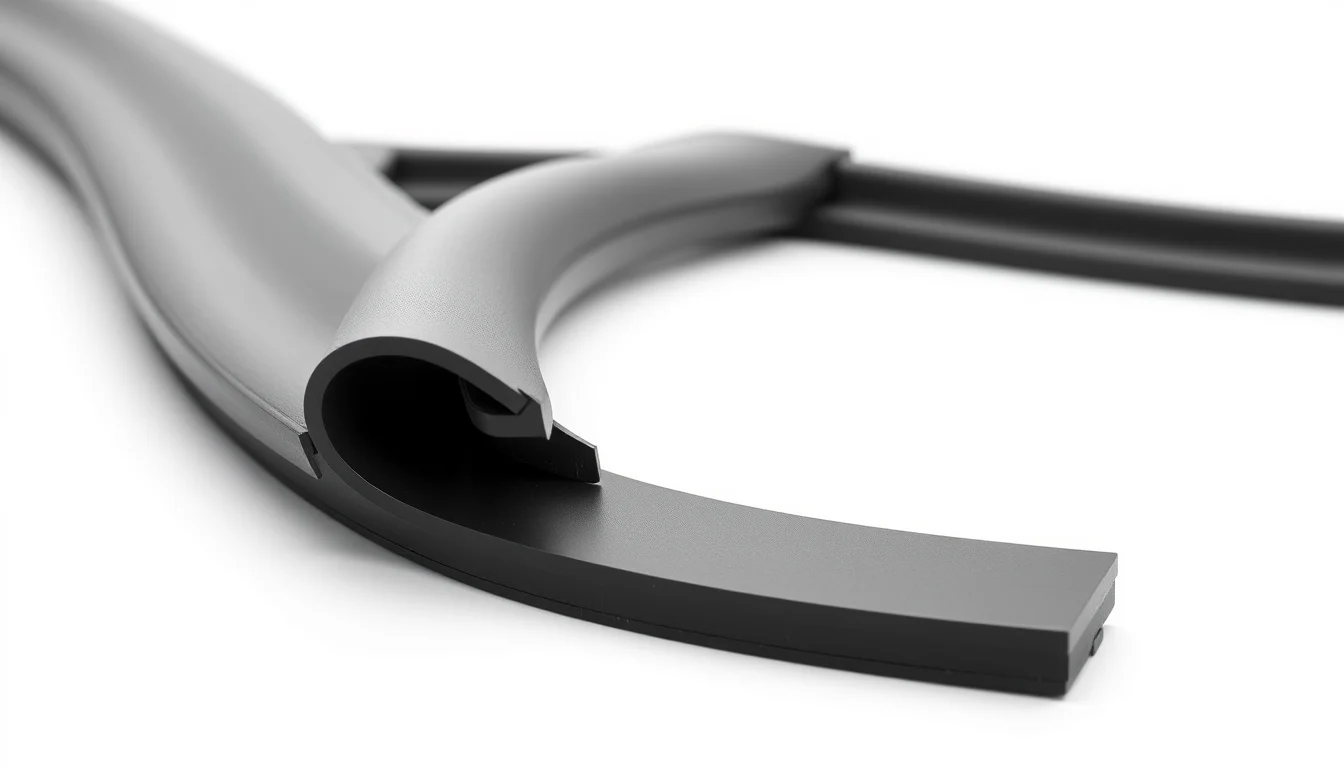
For automotive sunroof applications, the rubber seal must withstand UV exposure, thermal cycling from -40°C to 150°C, and dynamic compression without permanent deformation. The optimal material is a high-density EPDM compound with a Shore A hardness of 60-70, tensile strength ≥ 10 MPa, and a compression set of < 20% after 22 hours at 100°C per ASTM D395. Below is the technical comparison data your engineering team needs before specifying a supplier.
Material Matrix for Sunroof Sealing Profiles
Selecting the polymer matrix is the first critical decision. While silicone offers superior temperature range, EPDM provides better ozone resistance and lower cost for dynamic applications.
| Property | EPDM (Recommended) | Silicone (VMQ) | CR (Neoprene) |
|---|---|---|---|
| Shore A Hardness | 60-70 | 50-60 | 60-70 |
| Tensile Strength (MPa) | 10-15 | 7-10 | 10-12 |
| Compression Set (22h/100°C) | 15-20% | 10-15% | 25-30% |
| Continuous Temp Range | -40°C to 150°C | -60°C to 230°C | -30°C to 120°C |
| Ozone Resistance (ASTM D573) | Excellent | Excellent | Good |
| Oil / Acid / Alkali Resistance | Good / Good / Excellent | Good / Fair / Good | Excellent / Good / Good |
| Flame Retardancy (UL 94) | HB | V-0 (with additives) | HB |
| Relative Cost per Meter | $$ | $$$$ | $$$ |
Why EPDM Dominates OEM Sunroof Specs
EPDM's saturated polymer backbone provides inherent resistance to ozone and UV degradation, a primary failure mode for sunroof seals. In accelerated thermal aging tests per ASTM D573 (168 hours at 150°C), our EPDM compound retains 85% of its original tensile strength, whereas CR typically retains only 60-70%. For OEM buyers, this translates to a service life of 10+ years in real-world UV exposure.
Critical Mechanical Properties: What the Numbers Mean
Tensile Strength and Elongation
For a sunroof seal, tensile strength is less about load-bearing and more about resisting tear propagation during installation. We specify a minimum tensile strength of 10 MPa with an elongation at break of 300-400%. This ensures the lip of the seal can flex over the glass edge without micro-tears.
Compression Set: The #1 Performance Metric
Compression set measures the elastomer's ability to return to its original thickness after prolonged compression. A sunroof seal compressed between the glass and frame will take a permanent set over time, leading to wind noise and water leaks. Per ASTM D395 Method B, our standard sunroof compound achieves a compression set of 18% after 22 hours at 100°C. For high-end OEM projects, we offer a peroxide-cured variant that reduces this to 12%.
Fluid Resistance Data (ISO 1817)
Sunroof seals encounter rain, acidic bird droppings, and alkaline car wash chemicals. Our EPDM compound shows a volume swell of < 5% after 7 days immersion in distilled water and < 15% in standard reference oils (IRM 903). This dimensional stability is critical for maintaining extrusion tolerance of ±0.30 mm across the entire profile length.
Thermal Aging and Longevity Projections
We validate all sunroof compounds using ASTM D573 oven aging protocols. The table below shows typical retention of physical properties after 1000 hours of thermal aging.
| Aging Condition | Tensile Retention | Elongation Retention | Hardness Change (Shore A) |
|---|---|---|---|
| 100°C / 1000 hrs | 92% | 85% | +3 |
| 125°C / 1000 hrs | 85% | 75% | +5 |
| 150°C / 1000 hrs | 70% | 55% | +8 |
These figures indicate that for a vehicle operating in a moderate climate, a sunroof seal will maintain sealing pressure for 10-12 years before requiring replacement.
Manufacturing Tolerances and Cross-Section Design
Precision matters in sunroof sealing. A deviation of ±0.5 mm can cause a gap that produces 70 dB of wind noise at highway speeds. Our CNC-cut extrusion dies hold a cross-section tolerance of ±0.15 mm on critical sealing lips and ±0.30 mm on overall profile dimensions. We use laser micrometers in-line to verify 100% of production runs.
Vulcanization Process Control
Our continuous hot-air vulcanization line operates at 220°C with a residence time of 90 seconds, ensuring a consistent cure state across the profile. This is verified by periodic rheometer testing (MDR) to confirm the delta torque (MH-ML) stays within ±5% of the control spec.
Customization for OEM/ODM Programs
Sunroof profiles are rarely standard. We supply co-extruded profiles with a rigid PVC carrier for snap-fit installation and a spongy EPDM bulb for low closure force. For electric sunroofs, we also integrate a flocked surface on the sealing lip to reduce friction and noise.
In our Hunan factory experience, we have observed that most aftermarket sunroof seal failures are not due to material degradation but to improper compression set specifications. One project from a European distributor specified a 25% compression set limit, which we deemed too loose. We recommended our peroxide-cured compound with a 12% set limit. Field returns dropped from 3.5% to 0.4% after the change. Do not under-specify this parameter.
For non-sunroof applications, review our door sealing strips or silicone series for high-temperature environments. For static applications, our cabinet seals offer a cost-effective alternative.
Frequently Asked Questions
What is the minimum order quantity (MOQ) for a custom sunroof profile?
Our standard MOQ is 500 meters per profile for extruded EPDM. For existing tooling or standard cross-sections, we can accommodate orders as low as 200 meters. For co-extruded profiles with a PVC carrier, the MOQ is 1000 meters due to die complexity.
What is the lead time for a new sunroof seal extrusion?
Tooling fabrication takes 10-15 working days. First article samples are shipped within 3 days after tooling approval. Production lead time is 15-20 days after sample sign-off, depending on quantity. A 1000-meter order typically ships within 25 days from CAD drawing approval.
What cross-section tolerance can you guarantee?
We guarantee ±0.15 mm on sealing lips and ±0.30 mm on the overall profile. For critical dimensions, we can hold ±0.10 mm with in-line laser gauging and statistical process control. We recommend that your CAD drawing specifies critical sealing points for tighter control.
How is the product packed for export?
Sunroof seals are coiled in 1-meter diameter loops and secured with anti-compression spacers to prevent deformation in transit. Each coil is wrapped in kraft paper, then polyethylene film, and packed into export-grade plywood crates or palletized cartons. Standard packing is 50-80 meters per carton, depending on profile weight.
Can I get samples before placing a bulk order?
Yes. We provide free samples for standard profiles with 3-5 days delivery via DHL or FedEx. For custom profiles, we charge a nominal tooling sample fee, which is fully credited against your first production order. Send your CAD drawing to request a sample quote.
Specification Sheet for RFQ
When requesting a quote, include the following data points to expedite the process.
| Parameter | Recommended Value / Range |
|---|---|
| Material | EPDM (Peroxide-cured for low set) |
| Shore A Hardness | 60 ± 5 |
| Tensile Strength (MPa) | ≥ 10 |
| Compression Set (22h/100°C) | ≤ 20% |
| Operating Temp | -40°C to 150°C |
| Cross-section Tolerance | ±0.30 mm (critical: ±0.15 mm) |
| Aging Standard | ASTM D573 |
| Fluid Resistance | ISO 1817 |
Send your CAD drawing for a 24-hour quote.
Need a Custom Quote?
Send your CAD drawing or specs (material, hardness, profile, temperature range, MOQ) — our engineering team will respond within 24 hours.