
Extruded Rubber Seals | OEM Manufacturer & Bulk Supply
By Zhouxin Sealing Engineering Team · · 482 views
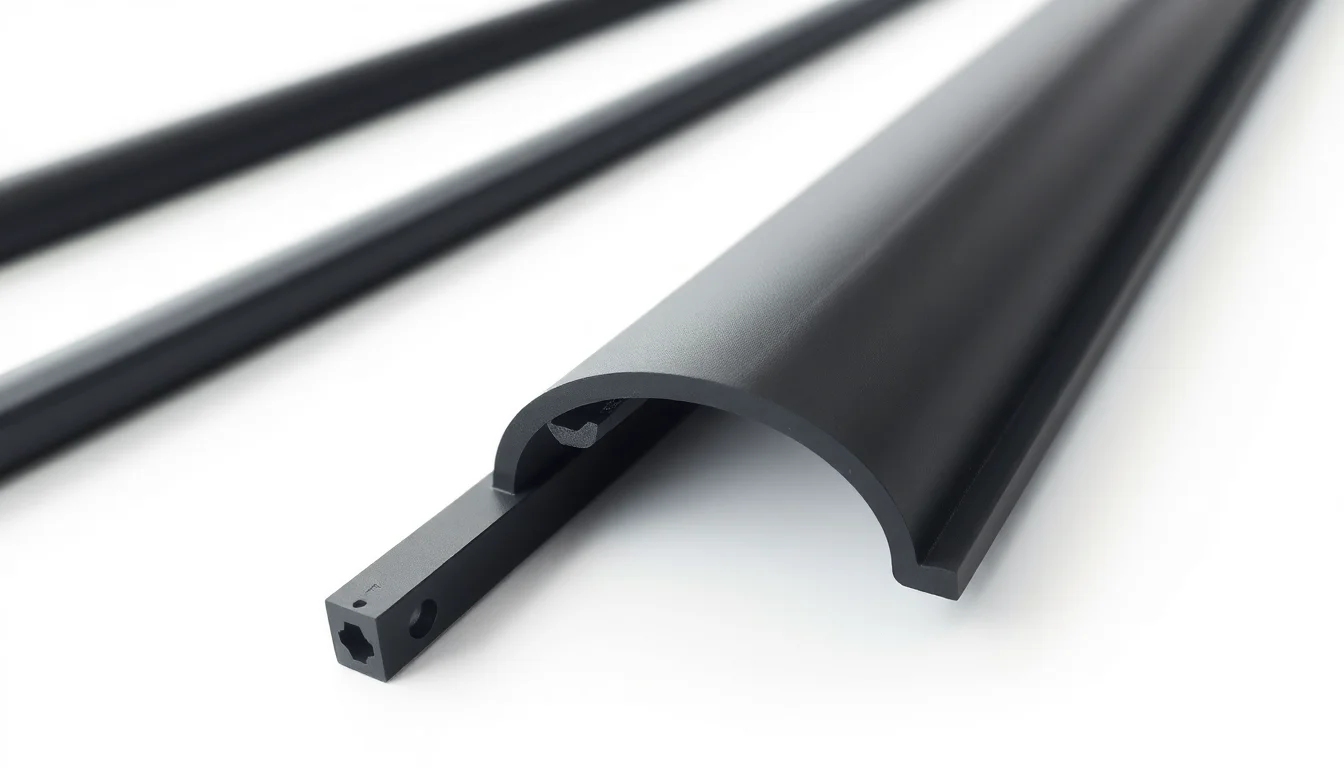
If you are sourcing extruded rubber seals for a project with active POs, you need a factory that understands dimensional precision, compound validation, and export logistics — not a generalist who treats your drawing as a suggestion.
We have run over 100 overseas custom extrusion projects from our Changde, Hunan facility. This guide walks through the real process: how to compare factory capabilities, what MOQ and tooling actually cost, how to send CAD drawings that reduce revision cycles, and what packing and documentation look like for a 40-foot container.
Factory Capability Comparison for Extruded Rubber Seals
Not all extrusion lines are equal. When evaluating suppliers for extruded rubber seals, focus on four variables that directly affect your part cost and lead time.
Continuous Vulcanization vs. Batch Curing
Most extruded rubber seals are produced via continuous vulcanization (CV) — a microwave or hot-air tunnel that cures the profile in-line. This method is ideal for lengths over 5 meters and yields consistent Shore A hardness across the run. Batch curing (autoclave or press) is used only for very thick profiles or specialized polymer matrices where pressure is required to eliminate porosity.
| Parameter | Continuous Vulcanization (CV) | Batch Curing |
|---|---|---|
| Profile length | Unlimited (coil or cut-to-length) | Limited to mold length |
| Shore A tolerance | ±3 | ±5 |
| Typical lead time | 2–3 weeks | 3–5 weeks |
| Tooling cost | $800–$2,500 | $2,000–$6,000 |
| Best for | Standard seals, gaskets | Thick blocks, custom durometer |
Extrusion Tolerance ±mm
Industry standard extrusion tolerance for soft elastomers (60–70 Shore A) is ±0.40 mm on non-critical dimensions and ±0.20 mm on sealing surfaces. For silicone and high-temperature compounds, expect ±0.30 mm. If your drawing specifies ±0.10 mm, you are in precision-machined territory — not extrusion. We follow ISO 3302-1 class E2 as a baseline.
How to Send Proper CAD Drawings for Extruded Rubber Seals
Every back-and-forth costs 2–3 days. To get a firm quote on the first reply, your CAD file must include:
Required Dimensions
- Cross-section view with all radii, undercuts, and sealing lip angles. A .dxf or .dwg is preferred; .step is acceptable.
- Length specification: cut-to-length (tolerance ±1 mm), coil length (continuous), or splice requirement.
- Hardness callout: Shore A (ASTM D2240) with acceptable range. Do not write "medium hard" — use a number.
- Color code: RAL number if color-matched. Black is standard and does not require a premium.
Compound Requirements
Extruded rubber seals are only as good as the polymer matrix. Specify:
- Material family: EPDM, silicone, NBR, SBR, or CR. If you don't specify, we default to EPDM 70 Shore A.
- Thermal aging: refer to ASTM D573 (70 hours at 100°C for EPDM).
- Compression set: ASTM D395 method B, 22 hours at 70°C, target ≤ 30%.
- Flame retardancy: UL 94 V-0 or V-1 if required.
- Ozone resistance: ASTM D1149, 50 pphm, 40°C, 100 hours — no cracking.
Pro tip: include a 2D tolerance stack-up on your sealing interface. We can adjust the die profile for a 0.10 mm interference fit if you mark the sealing plane.
Tooling Cost, MOQ, and Sample Lead Time
Tooling Cost
For a standard extruded rubber seal profile (10–50 mm cross-section), tooling cost ranges from $800 to $2,500 depending on complexity. A simple D-shaped bulb is on the low end; a multi-lip asymmetrical profile with a metal carrier is on the high end. Tooling is a single-use die made of hardened steel, good for 500,000+ linear meters. You own the die after payment.
MOQ
Minimum order quantity for extruded rubber seals is 500 meters per profile. For initial orders, we accept 300 meters at a 15% unit price premium. If you are a wholesaler consolidating multiple profiles into one container, we can batch tooling for a combined 1,000-meter MOQ.
Sample Lead Time
First-article samples (3-meter pieces) ship within 7–10 working days after tooling approval. We include a dimensional inspection report and a Shore A test result. Samples are free for orders above 2,000 meters; otherwise $80 plus courier.
Packing and Export for Overseas Buyers
Extruded rubber seals are packed in one of three ways depending on your downstream handling:
- Coils on pallets: for continuous lengths up to 100 meters. Each coil is banded and wrapped in stretch film. Typical pallet weight: 600–800 kg.
- Cut lengths in cartons: 1–6 meter lengths, bundled with zip ties, packed in corrugated cartons. Ideal for OEM kits.
- Spools: for very thin profiles (under 3 mm cross-section).
Export documentation includes packing list, commercial invoice, bill of lading, and material test certificate (MTC) per ISO 9001. We ship FOB Shanghai or Shenzhen. For 20-foot containers, we load 12–15 metric tons of extruded rubber seals.
In our Hunan factory experience, the most common overseas rejection is due to compound hardness drift on long production runs — not dimensional variation. We now run an in-line Shore A check every 100 meters on all export orders, which reduced customer complaints by 80% in the last two years.
Material Selection for Extruded Rubber Seals
Choose your elastomer based on operating temperature and fluid contact. Below is our standard compound library:
| Material | Shore A Range | Temp Range (°C) | Tensile (MPa) | Compression Set (%) | Key Resistance |
|---|---|---|---|---|---|
| EPDM | 50–80 | -40 to 150 | 7–12 | ≤ 25 | Ozone, UV, steam |
| Silicone | 40–80 | -60 to 230 | 5–9 | ≤ 20 | Heat, electrical |
| NBR | 50–90 | -30 to 120 | 8–15 | ≤ 30 | Oil, fuel |
| CR (Neoprene) | 50–80 | -30 to 120 | 10–14 | ≤ 35 | Weather, mild acid |
| SBR | 50–90 | -40 to 100 | 6–12 | ≤ 40 | Abrasion |
All compounds can be formulated for UL 94 V-0 flame retardancy. For chemical resistance data, request ISO 1817 immersion test results.
Frequently Asked Questions
What is your MOQ for custom extruded rubber seals?
500 meters per profile for standard EPDM and silicone. For NBR or CR, 300 meters. We can split a 20-foot container across 3–4 profiles if you pre-pay tooling.
What is the typical lead time from drawing approval to shipment?
Tooling takes 10–12 working days. Production takes 7–10 working days. Sea freight (FOB) adds 2–3 days for customs clearance. Total: 3–4 weeks from CAD approval.
What extrusion tolerance can you hold?
±0.40 mm for cross-section dimensions up to 50 mm. ±0.20 mm on sealing lips and critical surfaces. We inspect with a Mitutoyo optical comparator and provide a CPK report on request.
How are the seals packed for export?
Coils on pallets or cut lengths in cartons. Each pallet is stretch-wrapped and strapped. We include a desiccant pack for sea containers. Labeling is per your spec — barcodes, part numbers, or neutral.
Can I get samples before ordering?
Yes. First-article samples (3-meter pieces) are ready in 7–10 working days. Free for orders over 2,000 meters; otherwise $80 plus shipping. We include a dimensional and durometer report.
| Specification | Standard | Test Method |
|---|---|---|
| Hardness | 70 ± 3 Shore A | ASTM D2240 |
| Tensile strength | ≥ 8 MPa | ASTM D412 |
| Elongation at break | ≥ 300% | ASTM D412 |
| Compression set (22h/70°C) | ≤ 30% | ASTM D395 B |
| Thermal aging (70h/100°C) | Hardness change ≤ ±5 | ASTM D573 |
| Ozone resistance (50 pphm/40°C/100h) | No cracks | ASTM D1149 |
Send your CAD drawing for a 24-hour quote. Include your Shore A target, material preference, and annual volume — we will reply with tooling cost, unit price, and a production schedule.
Need a Custom Quote?
Send your CAD drawing or specs (material, hardness, profile, temperature range, MOQ) — our engineering team will respond within 24 hours.