
UV Resistant EPDM Window Strip | Bulk Supply Manufacturer
By Zhouxin Sealing Engineering Team · · 201 views
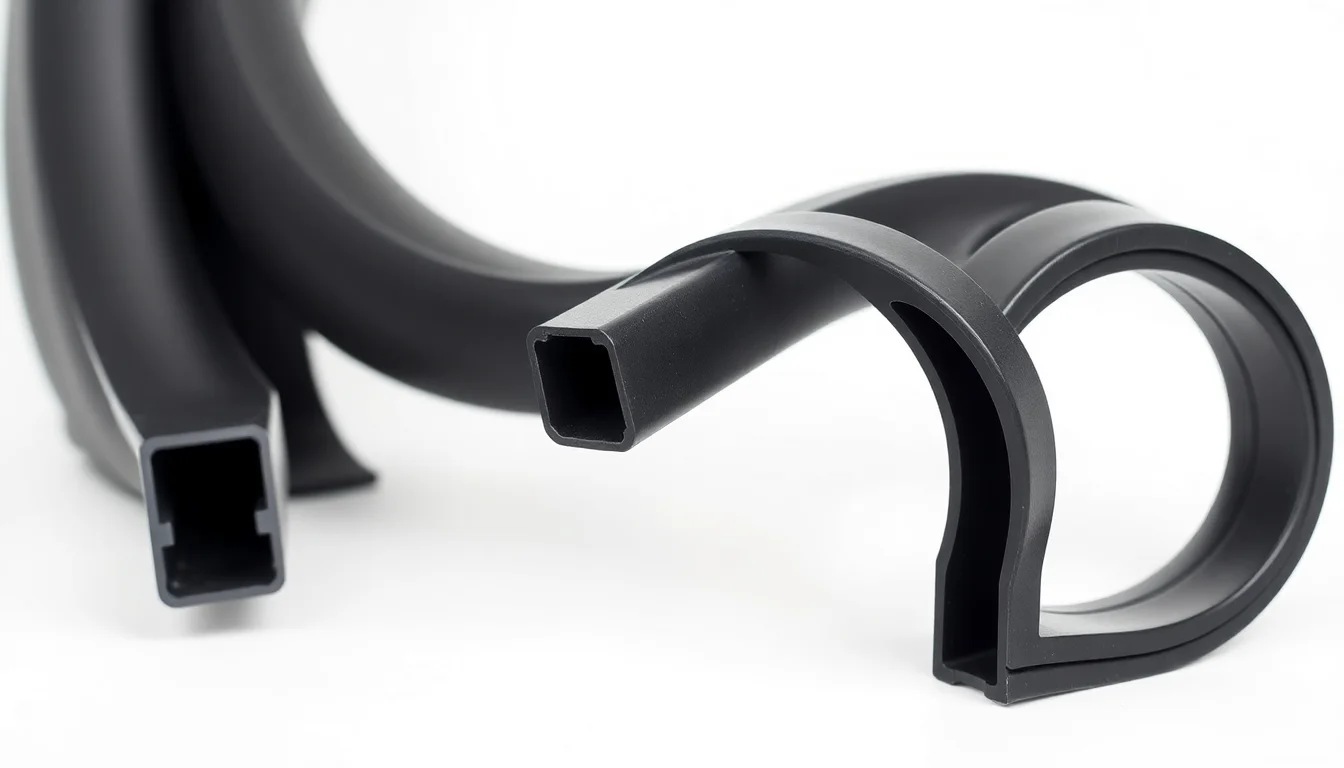
If you are sourcing a UV resistant EPDM window strip for a glazing project or OEM window frame, the critical procurement factors are not just the polymer grade but the extrusion tolerance, the compression set after thermal aging, and the factory's ability to match your CAD profile exactly without excessive tooling delays. This guide walks through the real custom extrusion process from a Chinese manufacturing perspective, covering MOQs, tooling costs, and how to send drawings that get quoted in one round instead of three.
Factory Capability Comparison: Why EPDM Grade Matters
Not all EPDM compounds are created equal. A window strip that sits in direct sunlight for 10 years requires a polymer matrix with a high ENB (ethylidene norbornene) content and a carbon black loading that resists UV degradation. When you send an RFQ, we compare three baseline compounds internally.
| Material Property | Standard EPDM (Low Cost) | UV Resistant EPDM (Recommended) | EPDM + EPDM Blend (Premium) |
|---|---|---|---|
| Shore A Hardness | 60 ± 5 | 60 ± 3 | 65 ± 3 |
| Tensile Strength (MPa) | 8.0 | 10.5 | 12.0 |
| Elongation at Break (%) | 250 | 350 | 400 |
| Compression Set (22h @ 100°C, %) | 35 | 25 | 18 |
| Thermal Aging (ASTM D573, 7d @ 100°C) | ±15% change | ±8% change | ±5% change |
| Ozone Resistance (ASTM D1149, 50pphm) | Cracks in 48h | No cracks 168h | No cracks 500h |
For a standard window flange seal, the middle column is your cost-performance sweet spot. The premium blend is for curtain wall systems where the strip must hold compression against glass for decades. We do not recommend the low-cost grade for any exterior UV application.
The Real Custom Extrusion Process: From Drawing to Shipping
Most overseas buyers assume extrusion is a simple process of melting rubber and pushing it through a die. In reality, the critical path involves three stages: die design, vulcanization, and post-cure finishing. Here is the step-by-step, as we execute it in our Changde facility.
Step 1: CAD Drawing Review and Tolerance Mapping
We receive your drawing (DWG, DXF, or PDF with dimensions). Our engineers map your nominal dimensions against our standard extrusion tolerances: ±0.3mm for cross-section dimensions up to 6mm, ±0.5mm for 6-12mm, and ±0.8mm for larger profiles. If your drawing specifies a tighter tolerance like ±0.15mm, we flag it immediately because that requires a CNC-machined die rather than a wire-cut one, increasing tooling cost by roughly 30%.
Step 2: Die Fabrication and Trial Run
A new profile requires a steel die. Tooling cost for a UV resistant EPDM window strip ranges from $350 to $900 depending on complexity (hollow bulbs, metal reinforcement channels, or asymmetrical shapes). Lead time for the die is 7-10 days. We then run a 2-meter trial sample through the line to check flow, surface finish, and dimensional stability.
Step 3: Vulcanization and Curing
Extruded EPDM is uncured. It passes through a hot air vulcanization tunnel or UHF microwave unit where the polymer cross-links. Temperature profiles are set between 160°C and 200°C. The line speed is adjusted based on the wall thickness of your strip. A thick base with a thin lip requires a slower speed to prevent under-curing in the thick section and over-curing in the thin section. This is where experience matters.
Step 4: Coiling, Cutting, and Packing
After curing, the strip is cooled, measured for length, and either coiled into bundles (for continuous lengths) or cut to exact lengths. For export, we use kraft paper interleaving and polypropylene film wrapping to prevent surface marking during transit. Coils are packed in cartons or on pallets depending on the total volume.
How to Send Proper CAD Drawings to Reduce Back-and-Forth
A poorly prepared drawing adds 3-5 days to the quotation cycle. Here is what we need in the first submission to give you a firm quote within 24 hours.
- Cross-section dimensions with tolerance callouts: Do not just give nominal dimensions. State that you need ±0.3mm or ±0.5mm. This determines the die manufacturing method.
- Material hardness specification: State the Shore A durometer you need. If you are unsure, specify the application (e.g., "static seal for glass frame") and we will recommend 60-70 Shore A.
- Flame retardancy requirement: If your project requires UL 94 V-0 or HB rating, note it. This changes the compound formulation and may affect the strip's color (usually black only).
- Surface finish: If you need a smooth matte finish, we use a different extrusion die surface. If you need a textured surface for better grip, specify it.
- Length and packaging format: State whether you want continuous coils (e.g., 50m rolls) or cut lengths (e.g., 1200mm pieces with 45° end cuts).
In our Hunan factory experience, the most common delay we see with overseas buyers is when they send a PDF of a drawing without dimension callouts or a tolerance block. We then have to email back for clarification, which costs you 24 hours. A single PDF with a tolerance table at the bottom saves everyone time.
MOQ, Tooling Cost, and Sample Lead Time
For custom UV resistant EPDM window strips, our MOQ is 500 meters per profile size. This is not an arbitrary number — it covers the cost of die setup, compound mixing, and line calibration. If you need less than 500 meters for a pilot project, we can offer a "sample run" at a higher per-meter price, usually 30-40% above the bulk rate.
Tooling cost is one-time and stays valid for 3 years. If you reorder the same profile after 2 years, we do not charge tooling again. If you modify the profile dimension by more than 1mm, a new die is required.
Sample lead time: 5-7 working days for a standard profile without flame retardant additives. If you need UL 94 V-0 rated EPDM, add 3 days for the compound batch to be mixed and tested.
Packing and Export Logistics
We pack for ocean freight, air freight, or express courier (DHL/FedEx/UPS). For ocean freight, strips are coiled and compressed into cartons of 20-25 kg each, then palletized with stretch wrap. A 20-foot container holds approximately 4,500 kg of EPDM strips. For air freight, we use vacuum packing to reduce volume. We handle all export documentation including commercial invoice, packing list, and certificate of origin. For orders over $5,000, we provide FOB Shanghai or CIF terms.
Frequently Asked Questions
What is your MOQ for a custom UV resistant EPDM window strip?
Our standard MOQ is 500 meters per profile. For a multi-profile order (e.g., 3 different profiles for a window system), the MOQ applies per profile. If you have a prototype project, we offer a 100-meter trial run at a 20% surcharge, which is deducted from your first bulk order if you proceed.
What is the tooling cost and who owns the die?
Tooling cost ranges from $350 to $900 depending on the cross-section complexity. You own the die once it is paid for. We store it free of charge for 3 years. If you need exclusive ownership and want the die shipped to you, we can arrange that at an additional freight cost.
What is the standard extrusion tolerance you hold?
For cross-section dimensions under 6mm, we hold ±0.3mm. For 6-12mm, ±0.5mm. For dimensions over 12mm, ±0.8mm. These are standard industry tolerances for EPDM extrusion. If you need tighter control, we can achieve ±0.15mm on critical sealing lips using a secondary grinding process, but this increases the unit price.
How do you pack for export?
For ocean freight, we coil the strip and pack in cartons with polypropylene film inside and kraft paper between layers to prevent surface scuffing. For air freight, we vacuum pack to reduce volume by 40%. We mark all cartons with profile number, length, and PO number for easy identification at your warehouse.
What is your sample policy for overseas buyers?
We provide up to 1 meter of sample free of charge, shipped at your cost (around $30-50 via DHL express). If you need a 5-meter sample for actual installation testing, we charge a nominal fee of $50 which is credited back to your first order. Samples are produced from the actual production die, not a lab extrusion.
Reference Standards for Your Specification
When writing your procurement spec, reference these standards to ensure your supplier tests correctly:
- ASTM D573: Standard test method for rubber—deterioration in an air oven (thermal aging).
- ASTM D395: Standard test methods for rubber property—compression set.
- ISO 3601: Fluid systems—O-rings (relevant if your strip has a circular cross-section).
- UL 94: Standard for safety of flammability of plastic materials (if flame retardancy is required).
- ISO 1817: Rubber, vulcanized—determination of the effect of liquids (for chemical resistance).
For a window strip, the two most critical tests are compression set after thermal aging (ASTM D395 Method B) and ozone resistance. A strip that passes both at 100°C for 70 hours will last 10+ years in a facade.
Ready to Source Your UV Resistant EPDM Window Strip?
Send your CAD drawing (DWG or PDF) with tolerance callouts and material hardness to our engineering team. We will respond with a firm quotation, tooling cost, and sample lead time within 24 hours. For related profiles, also review our door sealing strips or silicone series if your application requires higher temperature resistance. For cabinet or electrical enclosure seals, check our cabinet seals and WPC profiles.
| Specification | Our Capability | Standard Tolerance |
|---|---|---|
| Profile Width | 5 - 50 mm | ±0.5 mm |
| Profile Height | 3 - 30 mm | ±0.3 mm |
| Wall Thickness | 1 - 5 mm | ±0.2 mm |
| Shore A Hardness | 50 - 80 | ±5 |
| Tensile Strength | 8 - 12 MPa | ≥ specified min |
| Compression Set (22h @ 100°C) | ≤ 25% | ASTM D395 |
| Ozone Resistance (50 pphm, 168h) | No cracks | ASTM D1149 |
| Max Continuous Length | 100 m coil | No joints |
Send your CAD drawing for a 24-hour quote.
Need a Custom Quote?
Send your CAD drawing or specs (material, hardness, profile, temperature range, MOQ) — our engineering team will respond within 24 hours.