
Automotive Sunroof Rubber Seal | OEM Supplier & Custom
By Zhouxin Sealing Engineering Team · · 31 views
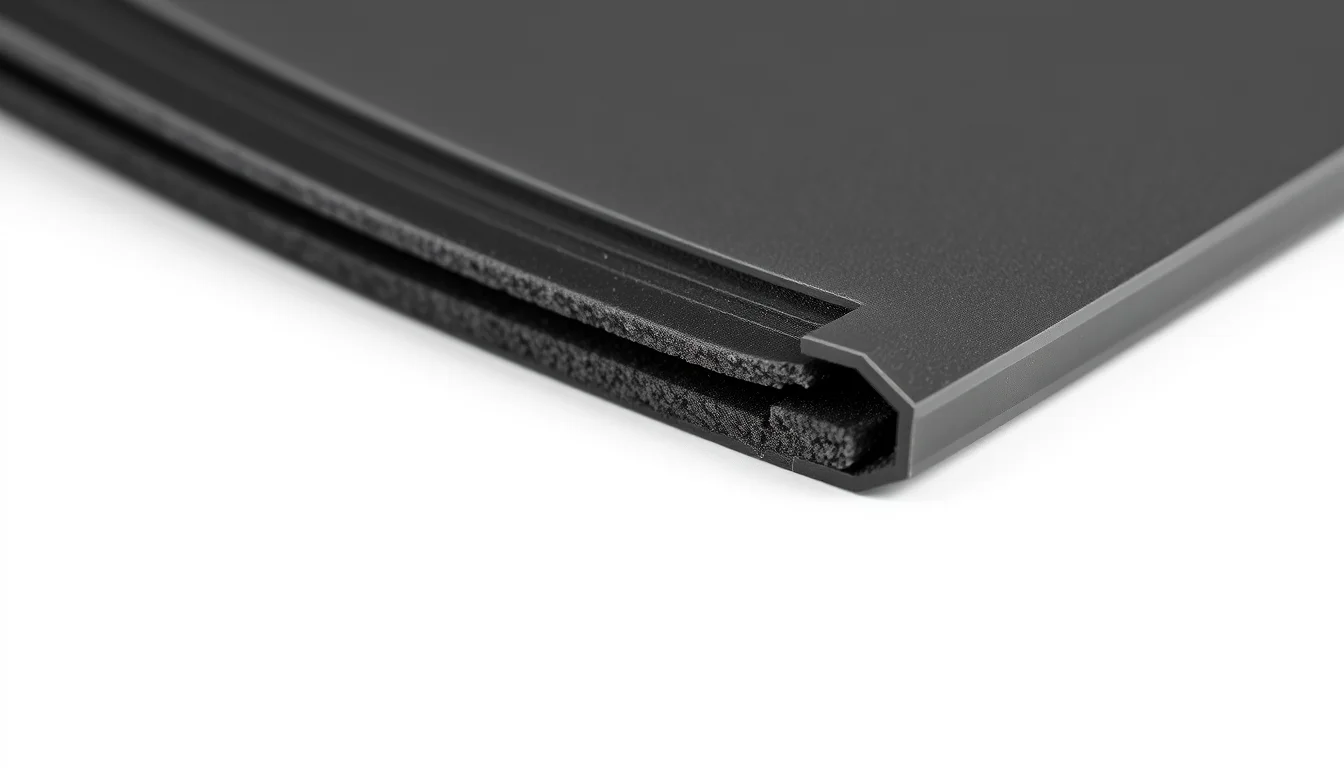
An overseas buyer sourcing an automotive sunroof rubber seal needs a factory that can hold ±0.3 mm extrusion tolerance, supply EPDM or silicone compounds tested to ASTM D573 and ASTM D395, and quote tooling and MOQ within 24 hours of receiving a clean CAD file. This guide walks through the real custom extrusion process, factory capability comparison, and the drawing details that cut back-and-forth to a single round.
What Separates a Capable Sunroof Seal Factory from a Trading Company
Extrusion, vulcanization, and post-processing under one roof
A sunroof seal is rarely a simple profile. It typically combines a dense EPDM bulb, a sponge sealing lip, a flocked sliding surface, and molded corners — sometimes with a dual-durometer polymer matrix. Factories that outsource flocking or corner molding lose control of dimensional stack-up. Look for continuous salt-bath or hot-air vulcanization lines, in-house flocking, and CNC corner splicing. Ask for the durometer map across the cross-section, not a single Shore A number.
Testing capability you can audit
Request thermal aging data per ASTM D573 (typically 70 h or 168 h at 100 °C), compression set per ASTM D395 Method B (often ≤25% at 70 h/100 °C), and ozone resistance at 50 pphm. A factory that runs these in-house can hold a PPAP submission; one that sends samples to a third party adds 2–3 weeks to every engineering change.
Material Selection Table for Sunroof Seals
| Material | Temp Range | Hardness (Shore A) | Tensile Strength | Compression Set | Relative Cost | Best For |
|---|---|---|---|---|---|---|
| EPDM (dense) | -40 to 120 °C | 60–75 | ≥10 MPa | ≤25% (70h/100°C) | $$ | Standard sunroof bulb and lip |
| EPDM (sponge) | -40 to 100 °C | 25–40 (Shore 00) | ≥3 MPa | ≤30% | $ | Soft sealing lip, low closing force |
| Silicone | -60 to 200 °C | 50–70 | ≥7 MPa | ≤30% | $$$ | High-temp, cold-climate, premium trims |
| TPV/TPE | -40 to 110 °C | 55–80 | ≥6 MPa | ≤35% | $$ | Recyclable, color-matched trims |
| NBR | -30 to 100 °C | 60–80 | ≥10 MPa | ≤25% | $$ | Oil-contact adjacent zones (rare) |
Numbers above reflect typical production windows — always confirm against the drawing's callouts and the OEM's material spec. For adjacent body-side profiles, see our door sealing strips range; for high-temp variants, the silicone series covers -60 to 200 °C.
The Custom Extrusion Process, Step by Step
1. Drawing review and DFM feedback
A competent factory returns a DFM note within 24–48 hours: wall thickness minimums, undercut warnings, corner radius feasibility, and flocking coverage. This is where most projects stall — buyers send a 2D PDF with no tolerance callouts, and the factory guesses.
2. Tooling and die design
Extrusion dies for sunroof profiles typically run USD 800–2,500 depending on complexity; corner molding tools add USD 1,500–4,000 per corner set. Lead time is usually 15–25 working days. Ask whether the die price includes a trial run and a first-article inspection report.
3. Compound mixing and extrusion
The polymer matrix is mixed to the approved formulation, then extruded through the die. Extrusion tolerance is the critical number: ±0.3 mm on critical sealing surfaces, ±0.5 mm on non-critical dimensions is a realistic production window. Tighter than ±0.2 mm requires post-cure grinding or a different process.
4. Vulcanization and post-cure
Continuous vulcanization sets the cross-link density. Post-cure (where specified) drives out volatiles and stabilizes compression set. Skipping post-cure is a common cause of field failures in hot climates.
5. Flocking, corner molding, and trimming
Flocked surfaces reduce sliding friction against the glass. Corner molding joins the extruded sections into a continuous loop; the joint strength and dimensional repeatability here determine whether the seal passes a water-leak test.
6. Final inspection and packing
Dimensional check against the drawing, hardness spot-check, and a visual for flocking coverage. Then coil or straight-length packing per the buyer's instruction.
In our Hunan factory experience, a European Tier-2 sunroof supplier sent a 2D PDF with a single ±0.5 mm general tolerance and no callout on the glass-contact lip. The first trial run passed dimensional inspection but failed a 500-cycle sliding test because the lip durometer drifted to 78 Shore A against a 65 ±5 target. We re-quoted with a durometer callout box on the drawing, added a 100% hardness check on the lip, and the second run passed. The lesson: put durometer, tensile, and compression set targets directly on the drawing — not in a separate email.
How to Send CAD Drawings That Get a Fast, Accurate Quote
What to include in the file package
- 3D STEP or IGES of the profile, plus a 2D PDF with tolerance callouts on every functional dimension
- Material spec: base polymer, hardness with tolerance (e.g., 65 ±5 Shore A), tensile minimum, compression set maximum, and any ASTM/ISO test methods
- Flocking requirement: coverage zone, fiber type, and friction target if specified
- Corner molding: joint locations, bend radii, and whether the loop is closed
- Packaging: coil ID/OD, straight-length, interleaving, and labeling
- Annual volume and release schedule — this drives MOQ and tooling amortization
Drawing conventions that reduce back-and-forth
Use a datum scheme tied to the mounting feature, not the extrusion start point. Call out extrusion tolerance separately from molded-corner tolerance. If the profile is dual-durometer, shade the zones and label each hardness. Reference ISO 3601 or the OEM's own spec where applicable. A clean drawing package typically cuts the quote cycle from 5–7 days to 24–48 hours.
MOQ, Tooling, Samples, and Export Logistics
| Item | Typical Range | Notes |
|---|---|---|
| MOQ (standard profile) | 500–1,000 m | Lower for repeat orders |
| MOQ (custom compound) | 2,000–3,000 m | Compound mixing batch minimum |
| Extrusion tooling | USD 800–2,500 | Includes trial run and FAI |
| Corner molding tool | USD 1,500–4,000 per set | Per corner geometry |
| Sample lead time (stock compound) | 7–12 working days | After drawing approval |
| Sample lead time (custom compound) | 15–20 working days | Includes compound development |
| Production lead time | 25–35 days | After sample approval |
| Packing | Coil, straight-length, or custom | Per buyer spec |
| Export terms | FOB Shanghai/Shenzhen, CIF, DDP | Incoterms 2020 |
For buyers also sourcing non-automotive profiles, our cabinet seals and WPC profiles ship on the same consolidation to reduce freight cost.
Frequently Asked Questions
What is the MOQ for a custom automotive sunroof rubber seal?
For a standard EPDM profile with an existing compound, MOQ is typically 500–1,000 meters. A custom compound or dual-durometer profile pushes MOQ to 2,000–3,000 meters because of compound mixing batch minimums. Repeat orders can often be released at half the initial MOQ.
What is the lead time from drawing to production?
Allow 15–25 working days for tooling, 7–12 working days for samples on a stock compound (15–20 for custom compound), and 25–35 days for production after sample approval. Total drawing-to-delivery is commonly 8–12 weeks for a new sunroof seal project.
What extrusion tolerance can you hold on a sunroof seal?
±0.3 mm on critical sealing surfaces and ±0.5 mm on non-critical dimensions is a realistic production window for EPDM extrusion. Tighter than ±0.2 mm requires post-cure grinding or a different process and should be discussed at DFM stage. Molded corners typically hold ±0.5 mm.
How are sunroof seals packed for export?
Coil packing (typically 50–100 m per coil, ID 300–400 mm) or straight-length per buyer instruction, with interleaving to prevent flocking damage. Cartons are export-grade with desiccant where humidity is a concern; pallets are fumigation-free. Labeling follows the buyer's barcode and traceability spec.
What is your sample policy?
Stock-compound samples are typically free; the buyer covers freight. Custom-compound samples carry a sample charge that is credited against the first production order. Samples ship with a first-article inspection report and material test data so the buyer can validate against the drawing before committing to tooling.
Send your CAD drawing for a 24-hour quote.
Need a Custom Quote?
Send your CAD drawing or specs (material, hardness, profile, temperature range, MOQ) — our engineering team will respond within 24 hours.