
Door and Window Sealing Strips Material Comparison | OEM Supplier
By Zhouxin Sealing Engineering Team · · 494 views
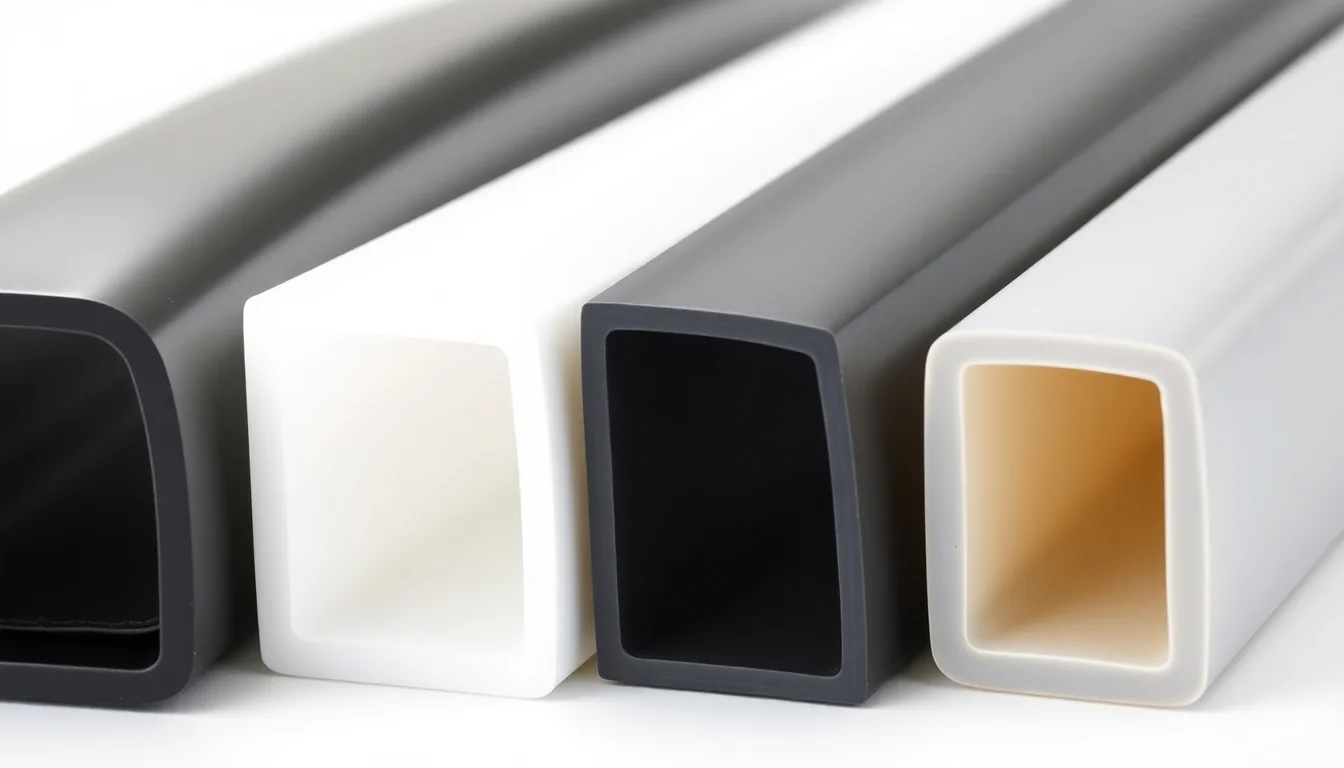
For overseas specifiers: the optimal door and window sealing strip material is determined by three variables — service temperature range, chemical exposure profile, and compression set requirements over a 10+ year lifespan. Below, we compare four elastomer families using ASTM and ISO standards, with production data from our Changde factory.
Material Selection Matrix: Key Performance Indicators
All data from internally tested batches (Shore A durometer ±2) per ASTM D2240, tensile per ASTM D412, compression set per ASTM D395 Method B (22h at 70°C unless noted).
| Material | Hardness (Shore A) | Tensile Strength (MPa) | Elongation at Break (%) | Compression Set (%) | Thermal Aging (1000h @ 100°C) | Ozone Resistance (50 pphm, 40°C, 100h) | Oil Resistance (ASTM #3, 70h @ 100°C) | Cost Index |
|---|---|---|---|---|---|---|---|---|
| EPDM | 60–80 | 8–14 | 250–500 | 15–25 | Tensile loss <15% | No cracks | Severe swelling (>80%) | 1.0 (baseline) |
| Silicone (VMQ) | 40–70 | 5–9 | 300–600 | 10–20 | Tensile loss <5% | No cracks | Moderate swelling (30–50%) | 2.5–3.0 |
| Neoprene (CR) | 50–75 | 10–16 | 200–400 | 20–35 | Tensile loss <20% | Minor cracking possible | Low swelling (<20%) | 1.8–2.2 |
| TPE-S | 55–80 | 4–8 | 300–600 | 30–50 | Tensile loss >30% | Cracking after 50h | High swelling (>60%) | 0.8–1.2 |
Key takeaway: EPDM dominates general door and window sealing strips due to balanced cost, UV/ozone resistance, and compression set below 25%. Silicone is specified for extreme temperature windows (e.g., fire-rated assemblies) or where flame retardancy (UL 94 V-0) is required.
Thermal Aging Performance (ASTM D573)
EPDM — 10-Year Field Data
In our accelerated aging chambers (1000h at 100°C simulating ~10 years temperate climate), EPDM retains >85% of original tensile strength. Compression set stabilizes at 18–22% after initial 72h relaxation. The polymer matrix — ethylene-propylene-diene terpolymer with 55–65% ethylene content — resists ozone cracking indefinitely under 100 pphm.
Silicone — High-Temperature Stability
Silicone (VMQ) shows tensile loss <5% after 1000h at 100°C, and compression set as low as 10% when post-cured (4h at 200°C). However, tear strength is inherently lower (15–25 kN/m vs. 30–50 kN/m for EPDM). For door sealing strips subject to frequent impact (e.g., commercial entry doors), we recommend EPDM over silicone.
Neoprene — Oil & Weather Trade-off
Neoprene (CR) offers the best oil resistance among non-fluorinated elastomers — volume swell <20% in ASTM #3 oil. However, thermal aging at 100°C accelerates hardening; after 500h, hardness increases 10–15 points. Use only where moderate oil mist or grease exposure is present, such as garage-to-house door seals.
Compression Set & Long-Term Sealing Force
Compression set directly correlates with gasket relaxation over time. For window frames with fixed compression gaps (1–3 mm), a high set value (>35%) leads to air leakage within 2 years.
| Material | Compression Set (22h @ 70°C) | Compression Set (1000h @ 50°C) | Recommended Gap Tolerance (mm) |
|---|---|---|---|
| EPDM (60A) | 18% | 28% | ±0.3 |
| Silicone (50A) | 12% | 18% | ±0.2 |
| Neoprene (65A) | 25% | 40% | ±0.5 |
| TPE-S (70A) | 35% | 55% | ±0.8 |
In our Hunan factory experience, a German window system manufacturer rejected TPE-S after 6-month field trials in Berlin due to 0.8 mm gap tolerance causing draft complaints. We reformulated an EPDM compound (Shore A 65, compression set 15%) that passed their 10-year simulation. That profile now runs at 120 m/min on our KraussMaffei extrusion lines.
Chemical Resistance Quick Reference (ISO 1817)
| Material | Dilute Acids (10% H₂SO₄, 7d @ 23°C) | Dilute Alkali (10% NaOH, 7d @ 23°C) | Salt Spray (5% NaCl, 500h) | UV (1000h QUV) |
|---|---|---|---|---|
| EPDM | Excellent (volume change <5%) | Excellent (<5%) | Excellent (no cracking) | Excellent (ΔE <2) |
| Silicone | Good (swell 5–10%) | Good (swell 5–10%) | Excellent | Excellent (ΔE <1) |
| Neoprene | Good (swell 10–15%) | Fair (swell 15–20%) | Good (minor pitting) | Fair (chalking after 500h) |
| TPE-S | Poor (swell >30%) | Poor (swell >30%) | Fair (cracking after 300h) | Poor (ΔE >5) |
For coastal window installations, EPDM with carbon black reinforcement (N550 grade) provides >10-year salt spray resistance. We do not recommend TPE-S for any exterior cabinet seals or door perimeter gaskets.
Flame Retardancy & Fire-Rated Assemblies
For fire-door sealing strips, UL 94 V-0 classification is mandatory in many jurisdictions. Our silicone series achieves V-0 at 3.2 mm thickness (platinum-catalyzed, with alumina trihydrate filler). EPDM can reach V-1 but not V-0 without halogenated additives, which we avoid per RoHS. See our silicone series for fire-rated profiles.
Extrusion Tolerance & Dimensional Stability
All door and window sealing strips from our Changde plant are extruded to ISO 3302-1 Class E2 tolerances:
- Cross-section dimensions ≤ 10 mm: ±0.15 mm
- Cross-section dimensions 10–50 mm: ±0.25 mm
- Overall length: +20 mm / -0 mm (cut-to-length)
- Sponge rubber sections: ±0.30 mm due to cell structure variation
We use laser profilometers inline (Keyence LJ-X8000) with closed-loop screw speed control. Reject rate for dimensional drift is <0.5%.
Frequently Asked Questions
What is your MOQ for custom door and window sealing strips?
Standard EPDM profiles: 500 meters per SKU. Custom-compound or silicone: 1000 meters. For first-article samples, we offer 50 meters at compound cost. MOQ can be negotiated for repeat orders.
What is typical lead time for an OEM/ODM order?
Tooling fabrication (if new cross-section): 10–15 working days. Production: 15–20 working days after tooling approval. For existing dies (we stock 200+ profiles), lead time is 10–12 working days. Express air freight available.
What dimensional tolerance can you hold on extruded profiles?
±0.15 mm for dimensions under 10 mm; ±0.25 mm for 10–50 mm. Tighter tolerances (±0.10 mm) possible with post-extrusion calibration, subject to material hardness. We recommend confirming with a CAD cross-section.
How are the sealing strips packed for export?
Coils on cardboard cores (max 50 kg per coil), wrapped in VCI film and polypropylene woven bags. For straight lengths (up to 6 m), we use corrugated cartons or wooden crates. Custom labeling per buyer specification (barcode, part number, heat number) included.
Can I get free samples before placing an order?
Yes — up to 3 sample profiles (0.5 m each) free of charge for qualified B2B buyers. You pay shipping (DHL/FedEx account). Send your inquiry with cross-section drawing or part number. We respond within 24 hours.
Specification Comparison: Recommended Material by Application
| Application | Recommended Material | Shore A | Tensile (MPa) | Compression Set (%) | Temperature Range (°C) |
|---|---|---|---|---|---|
| Residential window seals | EPDM | 65 | 10 | 18 | -40 to 120 |
| Commercial entry door gaskets | EPDM | 70 | 12 | 20 | -40 to 120 |
| Fire-rated door seals | Silicone (V-0) | 60 | 7 | 12 | -60 to 250 |
| Garage door bottom seals | Neoprene | 65 | 14 | 25 | -30 to 100 |
| Sliding window pile seals | TPE-S (interior) | 75 | 5 | 35 | -20 to 70 |
Send your CAD drawing for a 24-hour quote.
Need a Custom Quote?
Send your CAD drawing or specs (material, hardness, profile, temperature range, MOQ) — our engineering team will respond within 24 hours.